
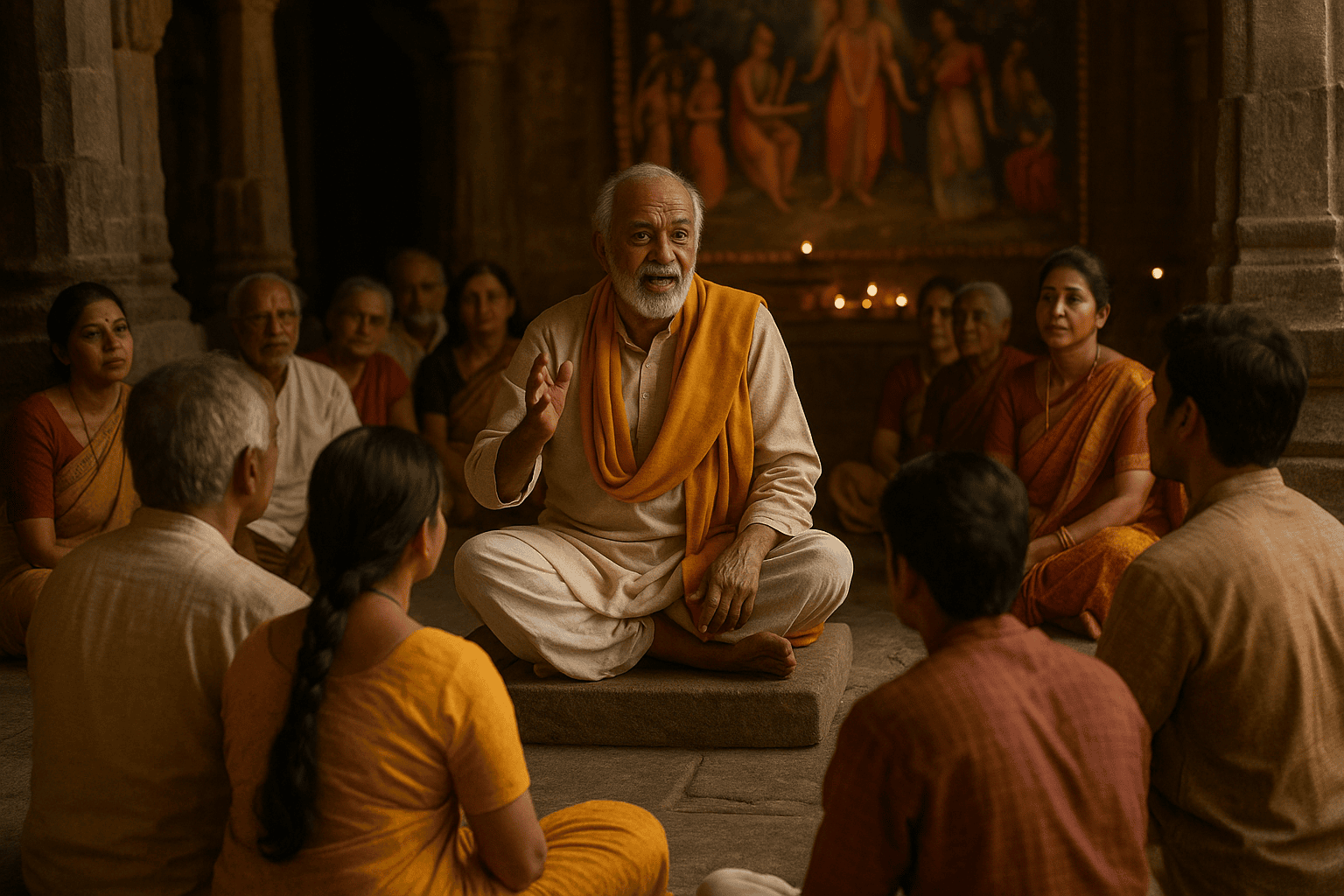
Storytelling in India has always been more than entertainment. It is a sacred practice, a way of passing wisdom from one generation to another, shaping moral imagination, and nourishing the soul. From the hymns of the Vedas to the folk songs sung in cultural events, stories in Indian culture have carried within them questions of life, guidance for living, and a sense of belonging to something greater than oneself.
The ancient Vedas and Upanishads hold some of the earliest examples of storytelling as philosophy in motion. These texts are not simply collections of hymns and teachings; they are alive with dialogue and narrative. One of the most moving tales is the dialogue between young Nachiketa and Yama, the god of death, in the Kathopanishad. Nachiketa, with fearless innocence, questions Yama about the mystery of life and the self beyond death. In this way, the highest truths of existence were not preached but revealed through a story—one that could be remembered, retold, and lived by those who heard it.
As Indian culture evolved, the great epics, the Ramayana and the Mahabharata, became more than literary treasures—they turned into manuals for life. They dramatize the complexities of human relationships, duty, and choice through unforgettable characters like Rama, Sita, Arjuna, and Krishna. These stories hold mirrors to our own struggles, teaching resilience, love, and courage. Even the subplots, such as Savitri’s steadfast devotion or Nala and Damayanti’s trials, highlight virtues that people continue to aspire toward. At the heart of the Mahabharata lies the Bhagavad Gita, a dialogue that demonstrates how the most profound philosophical guidance can emerge in the midst of conflict and despair.
The Puranas further translated cosmic and spiritual concepts into symbolic tales accessible to all. Through the stories of Krishna’s playful lila, or the descent of the Ganga to earth, deep truths about devotion, divine play, and the cycle of creation became experiences that stirred both intellect and emotion. By framing the infinite in imagery and narrative, these stories gave ordinary people a way to connect with extraordinary truths.
Other traditions such as the Jataka Tales and Panchatantra carried practical wisdom in the form of simple fables. Here, animals spoke and acted like humans, teaching children and rulers lessons of honesty, patience, cleverness, and strategy. Their compact plots made life’s most important values memorable and easy to recall when decisions had to be made.
The Bhakti movement later added an even more personal touch to storytelling. Saints like Mirabai, Kabir, Tukaram, and Andal expressed devotion, humility, and spiritual courage through songs and poems. Their stories, carried by voice and rhythm, invited communities to live in love, simplicity, and faith. Folk traditions such as Harikatha, Yakshagana, and Pandavani wove together music, theatre, and narration, transforming storytelling into communal experience where entertainment and spiritual nourishment flowed together.
Even today, these stories matter. In our fast-paced and fragmented lives, they reconnect us with roots, ground us in values, and help us reflect on who we are and who we wish to become. They are not relics of the past but living maps that guide us through dilemmas, struggles, and joys. They teach resilience, cultivate empathy, and remind us that meaning often lies not in quick answers but in timeless questions.
From a therapeutic lens: How Stories Heal
From the perspective and experience as a therapist, stories are also deeply healing.
1. They provide a safe space where individuals can see their own fears, struggles, and hopes mirrored in the journey of a character. Because the struggles belong to “someone else,” it becomes easier to talk about them, reflect on them, and eventually find personal meaning.
2. Stories help people process emotions like grief, fear, or anger without direct confrontation.
3. They transform suffering into lessons and show how challenges can become opportunities for growth.
4. For children, stories nurture imagination, empathy, and problem-solving skills.
5. For adults, they offer reflection, perspective, and sometimes even a sense of closure or renewal.
6. Most importantly, sharing stories builds connection—reminding us that we are never alone in our journeys.
To honour and revive this soulful tradition is to go beyond merely repeating old tales. It is about finding ways to bring their wisdom into our modern lives. Whether told in a temple, a classroom, a therapy room, or a living room, stories remain one of the most powerful tools we have—for educating the mind, awakening the heart, and keeping alive the threads of community and culture.
Storytelling is about guiding the present and shaping the future. Each story whispers that within every struggle lies wisdom, within every heart lies resilience, and within every life lies the chance to live more meaningfully.